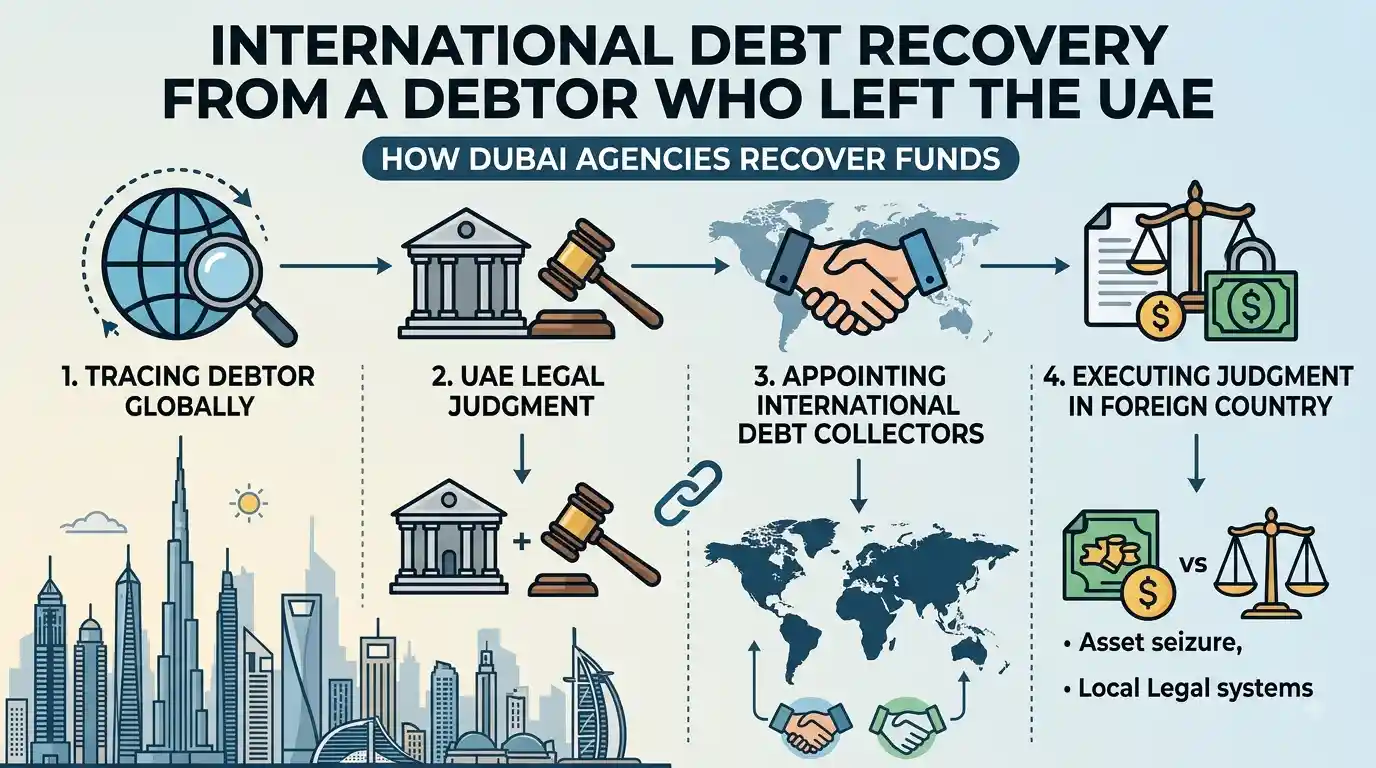
Yes, a debt collection agency in Dubai may be able to pursue a debtor who has left the UAE, but the available recovery options depend on the type of debt, the supporting documents, the amount involved, and the debtor’s current location. Leaving the UAE does not automatically cancel a person’s financial obligations or prevent a creditor from pursuing lawful recovery.
For businesses and individuals dealing with unpaid amounts, understanding how Debt Collection Dubai works when a debtor is outside the country can help determine the most appropriate next step.
Does Leaving the UAE Stop Debt Collection?
No. A debtor leaving Dubai does not necessarily stop collection efforts. A creditor can continue communicating with the debtor and may explore legal remedies where appropriate.
For example, a person may leave Dubai while owing money under a personal loan, credit-card agreement, tenancy arrangement, commercial contract, or unpaid invoice. The creditor can review the available documentation and determine whether further recovery action is appropriate.
A debt collection agency may initially attempt an amicable resolution rather than immediately pursuing litigation. This can include contacting the debtor, confirming the outstanding balance, discussing repayment options, and negotiating a settlement.

How Does Debt Collection Dubai Work When the Debtor Is Overseas?
International debt recovery can be more complicated than recovering money from someone who remains in Dubai. However, physical absence does not necessarily make recovery impossible.
A collection process may involve several stages:
Reviewing the debt: The creditor or collection professional examines contracts, invoices, payment records, correspondence, guarantees, and other relevant documents.
Contacting the debtor: The debtor may be contacted through lawful communication channels to request payment or discuss the outstanding balance.
Negotiating repayment: Where the debtor is willing to resolve the matter, the parties may agree to instalments or a settlement.
Legal assessment: If voluntary recovery fails, the creditor can assess whether formal legal proceedings are appropriate.
Cross-border recovery: If legal enforcement is required in another country, local legal procedures in that jurisdiction may become relevant.
The exact process varies according to the circumstances.
Can a Debt Collection Agency Contact a Debtor in Another Country?
A collection agency may be able to communicate with a debtor who has moved overseas, subject to applicable laws governing debt collection, privacy, communications, and cross-border activities.
Communication may take place through methods such as email, telephone, written correspondence, or through legal representatives.
However, professional debt collection should remain lawful and appropriate. A legitimate Debt Collection Dubai process should focus on recovering a genuine debt rather than using threats, harassment, intimidation, or improper disclosure of information.
What Documents Are Needed for Debt Recovery?
Strong documentation can make debt recovery significantly easier.
Depending on the circumstances, relevant documents may include:
- Signed contracts
- Loan agreements
- Credit agreements
- Invoices
- Purchase orders
- Delivery records
- Account statements
- Payment records
- Written acknowledgments of debt
- Personal guarantees
- Emails and business correspondence
- Settlement agreements
For commercial debt, it is particularly important to establish the contractual relationship between the parties and demonstrate that the amount claimed is actually due.
A Debt Collection Dubai professional can review these documents and identify gaps before recommending further action.
Can a Creditor Negotiate With a Debtor Who Lives Abroad?
Yes. Negotiation can sometimes be one of the most practical approaches when a debtor has left the UAE.
The parties may discuss:
- Full repayment
- Monthly instalments
- A discounted settlement
- A payment deadline
- Restructuring
- Partial payment followed by scheduled instalments
The appropriate solution depends on the creditor’s objectives and the debtor’s financial circumstances.
A written settlement agreement can be particularly important because it can clarify the agreed amount, payment schedule, deadlines, and consequences of non-payment.
What Happens If the Debtor Refuses to Pay?
If the debtor refuses to pay and informal collection attempts fail, the creditor may consider formal legal options.
The appropriate procedure depends on the nature of the debt and the applicable jurisdiction. A creditor may need to establish the debt through appropriate legal proceedings before pursuing enforcement.
Where the debtor is outside the UAE, additional questions may arise concerning jurisdiction, recognition of judgments, and enforcement in the debtor’s country of residence.
Because international enforcement can involve different legal systems, creditors should obtain appropriate legal advice rather than assuming that a UAE-based debt can automatically be enforced in another country.
Can International Companies Use Debt Collection Dubai Services?
Yes. International companies may have UAE-based customers, distributors, suppliers, contractors, or business partners who fail to pay their obligations.
For example, a foreign company may supply products to a Dubai-based business under a commercial agreement. If invoices remain unpaid, the creditor may seek professional assistance with recovery.
Similarly, a UAE company may need to recover money from an overseas customer. In such cases, a Debt Collection Dubai professional may assess the available recovery options and determine whether cooperation with professionals in another jurisdiction is necessary.
Is It Better to Settle a Debt Before Leaving Dubai?
Where possible, resolving a debt before departure can reduce potential complications.
A debtor who knows that they cannot pay the entire amount may contact the creditor and discuss alternatives. Depending on the situation, the creditor may be willing to consider a structured payment arrangement or negotiated settlement.
Resolving the matter before leaving can also provide clearer documentation showing that the obligation has been satisfied or that an agreed repayment plan is in place.
However, each situation is different. Someone who has already left Dubai should not assume that it is too late to negotiate.
What If the Debtor Has UAE Assets?
A debtor living abroad may still have financial or business interests in the UAE. Depending on the circumstances and applicable legal procedures, those assets may become relevant to recovery.
Potentially relevant assets could include certain:
- Bank funds
- Business interests
- Receivables
- Property interests
- Other recoverable assets
Whether a particular asset can be targeted depends on the legal status of the debt and the applicable enforcement rules. A creditor should obtain appropriate legal advice before taking enforcement action.
How Long Can Debt Collection Take?
There is no universal timeframe for debt recovery.
An uncomplicated debt may be resolved relatively quickly through direct negotiation, while a disputed commercial debt or international recovery matter may take considerably longer.
Factors affecting the timeline can include:
- Whether the debtor responds
- Whether the debt is disputed
- Quality of supporting documentation
- Amount involved
- Complexity of the contractual relationship
- Whether court proceedings are required
- Location of the debtor
- Availability of assets
- Enforcement requirements
For this reason, creditors should avoid relying on a fixed timeline when planning a recovery strategy.
Should a Creditor Hire a Debt Collection Agency or a Lawyer?
The appropriate choice depends on the circumstances.
A collection agency may be useful when the primary objective is professional communication and amicable recovery. A lawyer may be particularly important when the matter involves a substantial dispute, litigation, contractual interpretation, or enforcement proceedings.
In some cases, these functions can complement each other. A creditor may begin with professional collection efforts and obtain legal assistance if voluntary recovery is unsuccessful.
For complex commercial or international debts, early legal assessment can help prevent unnecessary delays and expenses.
What Should Creditors Do If a Debtor Has Disappeared?
If a debtor has stopped communicating and apparently left Dubai, the creditor should organize all available evidence relating to the debt.
Useful information may include:
- The debtor’s last known contact details
- Contractual documents
- Outstanding invoices
- Payment history
- Previous correspondence
- Company information
- Guarantees
- Information concerning known business relationships
The creditor should also avoid using unlawful methods to locate or pressure the debtor. Professional Debt Collection Dubai services can help identify lawful recovery strategies based on the available information.
Final Thoughts
A debtor leaving the UAE does not automatically bring a debt to an end. Depending on the circumstances, creditors may still have options for amicable recovery, legal proceedings, or cross-border enforcement.
The best approach is usually to assess the debt carefully before deciding what action to take. Strong documentation, clear communication, appropriate negotiation, and timely legal advice can all improve the prospects of recovery.
If you are trying to recover an unpaid personal, commercial, or contractual debt, a professional Debt Collection Dubai service can help evaluate the circumstances and determine whether negotiation, formal legal action, or another recovery strategy is appropriate.
Related Reading: SMOK Nord 5 vs Nord 4: What’s the Real Difference?
Related Reading: DUBAI noticias: El crecimiento de las startups en Emiratos Árabes Unidos — full guide
Related Reading: What Should I Wear When Meeting a Dubai Escort? — full guide
Related Reading: How Much Does a Criminal Lawyer in Dubai Cost?