Modern FPV drones have evolved far beyond simple radio-controlled aircraft. The emergence of AI-powered drones with onboard computer vision has redefined what precision means in tactical applications. This article breaks down the essential hardware components that enable terminal-phase guidance, clarifies the actual role of the operator in these systems, and outlines what engineers and procurement specialists need to evaluate when selecting a platform.
How AI Guidance Actually Works — and What the Operator Controls
A persistent misconception surrounds AI-assisted FPV systems: that the drone operates independently from launch to impact. This is not accurate. The operator pilots the drone throughout the entire flight, directing it toward the target using a live video feed and a standard radio control link. Only during the final approach — the terminal phase — do onboard algorithms engage, using machine vision to refine the trajectory and guide the drone to the designated point of impact.
This architecture places meaningful human judgment at every stage of the mission. The AI layer corrects for environmental variables — wind, vibration, target surface irregularities — that are difficult to compensate for manually at high approach speeds. The result is improved accuracy without removing the operator from the decision-making process.
Onboard Compute: the Processing Core of Terminal Guidance
Executing real-time inference at the edge requires hardware that would have been impractical in small airframes just a few years ago. Today, compact system-on-chip (SoC) modules with integrated neural processing units (NPUs) make it possible to run object detection and tracking pipelines locally, without any network dependency.
The compute subsystem in a capable guidance platform typically includes:
- an NPU or embedded GPU capable of running INT8 quantised neural network models at 30-60 fps;
- a dedicated flight controller that receives corrective outputs from the vision pipeline with sub-10 ms latency;
- 1-2 GB of low-power RAM to hold inference model weights alongside active frame data;
- a power management unit that isolates the compute load from the propulsion and control electronics.
Hardware integration at this level requires careful validation — not just of individual components, but of the full pipeline under real flight conditions, including vibration and thermal stress.
Weight remains a hard constraint. Every gram added to the compute module reduces flight endurance or payload capacity, so component selection involves rigorous trade-off analysis.
Camera and Imaging Hardware for Machine Vision Pipelines
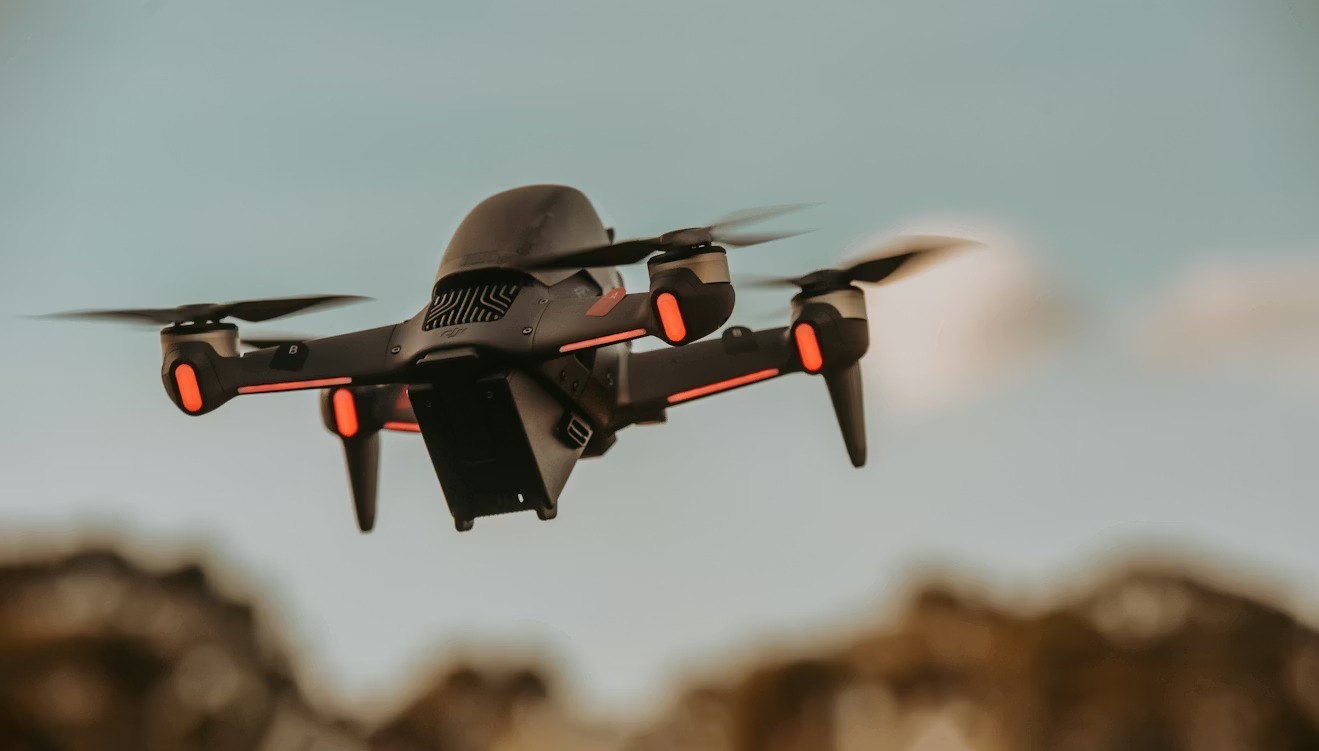
The imaging subsystem determines the quality and reliability of target acquisition during the terminal phase. Consumer FPV cameras designed for human piloting introduce motion blur, inconsistent exposure, and rolling shutter artefacts — all of which degrade neural network inference accuracy.
Platforms built for machine vision guidance, including those developed by SkyCraft, use imaging hardware selected specifically for algorithmic processing rather than human viewing comfort. A suitable camera configuration for terminal guidance includes:
- a global shutter sensor to eliminate per-row exposure timing differences at high approach velocities;
- a native resolution of 720p-1080p at 60-120 fps to provide sufficient spatial detail at operational distances;
- a hardware-level ISP with fixed or tightly managed exposure curves to maintain consistent input to the inference model.
Some configurations add an infrared or low-light channel to extend effective operational conditions beyond daylight hours. Sensor choice directly influences the confidence threshold at which the guidance algorithm engages.
Power Budget and Thermal Constraints in Compact Airframes
| Subsystem | Typical Power Draw | Thermal Concern |
| NPU / SoC compute module | 2‒5 W | High — sustained inference load |
| Flight controller | 0.5‒1 W | Low |
| Camera and ISP | 1‒2 W | Moderate |
| Radio control link | 0.5-1 W | Low |
Running neural inference continuously places a sustained load on the battery that conventional FPV designs do not account for. Battery selection must consider both capacity (mAh) and continuous discharge rate (C rating) to avoid voltage sag under combined motor and compute load.
Thermal management without active cooling — fans add weight and failure points — means the SoC must either operate within its passive thermal envelope or limit inference to the terminal phase only. The latter approach reduces total energy consumption and heat generation while preserving full guidance accuracy during the seconds it is most critical.
Choosing hardware for an AI-assisted FPV platform is an exercise in constrained optimisation: compute performance, imaging fidelity, power endurance, and airframe weight must all be balanced against each other. The operator remains central to every mission; the hardware exists to make the final phase of that mission as precise as possible.